
DAMILAH’S MULTI-AGENT PLATFORM
Barriers to value creation with AI
All companies report a mix of results from AI when it comes to cost and productivity. The most common challenges we hear from CTOs and technology leaders include:

Uncontrolled AI spend:
Without token-level tracking, teams have no way to anticipate or manage the cost of running AI at scale.

Limited visibility:
Leaders have limited insight into what AI agents are producing or whether outputs meet their standards.

Scaling breaks everything:
AI tools often fall apart when you try to scale across teams and clients.

Fragmented AI tooling:
Individual AI assistants running in silos, with no shared context or coordination across teams.
One platform to orchestrate AI-driven development
The solution to these challenges is AI orchestration. Damilah’s Multi-Agent Platform sits above individual large language models. It connects them into governed, configurable workflows that span every stage of the Software Development Lifecycle (SDLC). We use DMAP to transform the way we do business, increasing our productivity and therefore lowering cost on our customers’ projects. With clear visibility at every stage and multiple AI agents working as one team alongside humans, we can ensure the highest quality standards are maintained on any project.
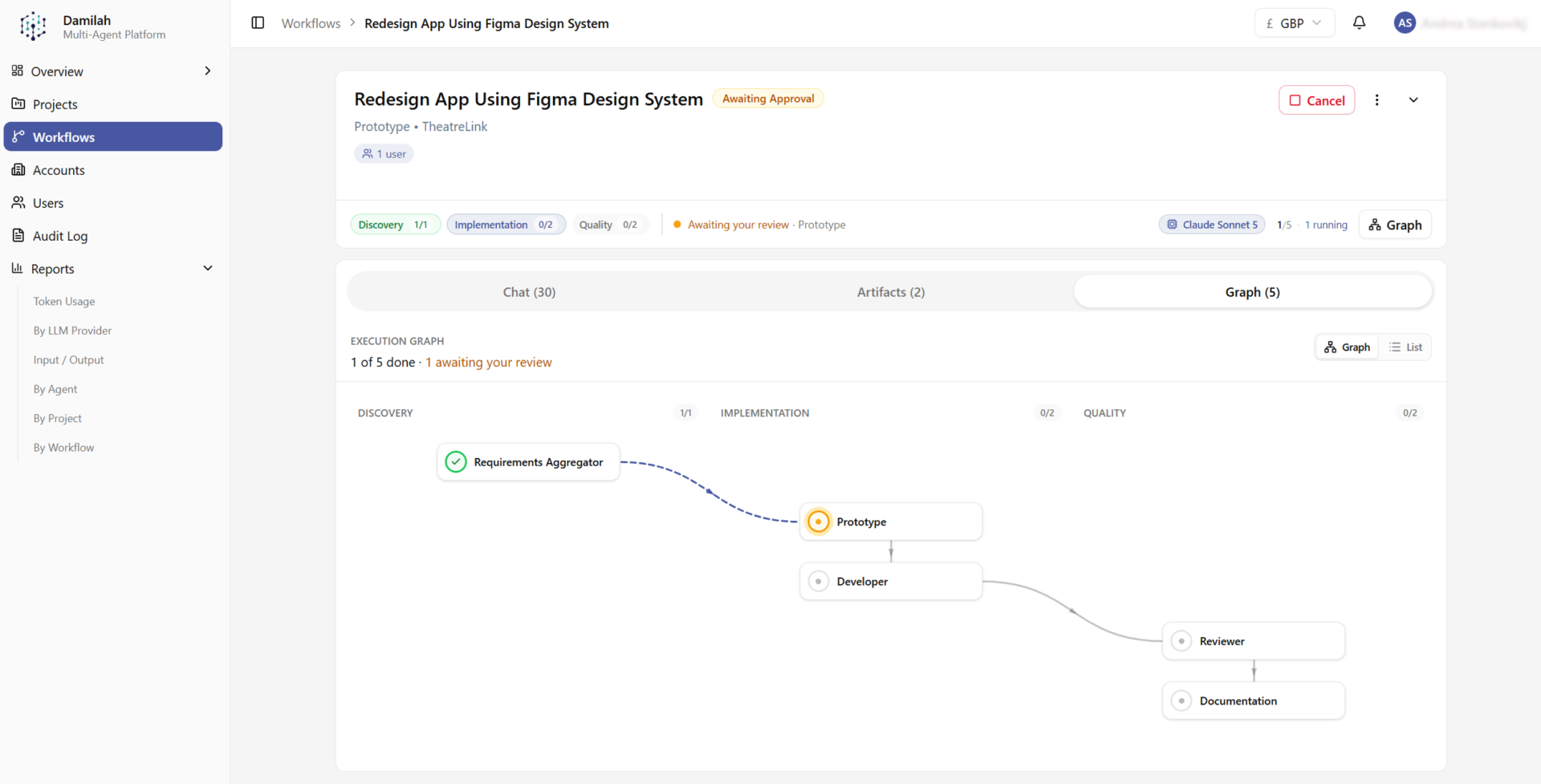
Below is a screenshot of how the Reviewer agent runs and executes the code produced by the Developer agent, to verify that the artefacts meet the requirements and goals.
Seven key integrated capabilities
Explore how DMAP runs AI across the SDLC, built around the realities of engineering teams, with quality at the centre. The LLM routing capability is called out separately, as companies frequently tell us they are struggling with changes to LLM cost models. We predict this feature to become increasingly important for our customers.
Real-time cost visibility & LLM routing
DMAP tracks token consumption, breaking down exactly what each LLM run costs. Based on your input & config DMAP can recommend the right LLM. Forecast spend before it happens and compare model efficiency across tasks.
Workflow orchestration & human in the loop
Run and execute multi-agent workflows across the entire SDLC. Agents work in sequence or in parallel, informed by your standards, codebase, and context. Humans with deep expertise review and approve at critical checkpoints within the workflow.
Document ingestion
Import your standards, guidelines, and design systems directly into both workflows and projects. Agents operate with your organisation’s knowledge baked in.
Model Context Protocol (MCP) integration
Native connectivity with GitHub, Azure DevOps, and other tools in your development toolchain, feeding context in and writing artefacts back out.
Governance & audit
Role-based access, a full audit and code-change trail, anomaly alerts, and compliance controls.
Dashboards & live reports
Real-time visibility into every workflow’s status, agent activity, and output. Audit log for user activity as well as agents.
Project & user management
Organise workflows and access across teams and projects. Scale AI operations without losing control of who can do what.
Human in the loop
Built by the people using it, DMAP is a winning combination of human + AI. We set out to solve our own challenge: how do you run AI agents across multiple client projects, at speed, without losing governance or accumulating unpredictable costs? Now we’re able to solve our clients’ challenges at speed, enabled by DMAP and our company-wide AI expertise.
Our human experts review every stage of delivery and development. Our AI agents work for our team, who work closely alongside yours to achieve your project outcomes in a fraction of the time.
See DMAP for yourself
Ready to see what AI can do at scale for your product, while you’re in control?
Join us for a personal demo tailored to your organisation’s workflows. We’ll show you DMAP running live, including real-time cost attribution, and walk through what it would look like in your environment.