
Software developers can make huge productivity gains through the adoption of AI tools – sometimes with speed increases of up to 20x. That was the outstanding conclusion of our recent CTO Roundtable, Exploring AI-Driven Productivity in Software Development, hosted by Iain Bishop and Aleksandar Karavasilev, CEO and CTO of Damilah Technology.
Kicking off the event, they presented the findings from a series of controlled experiments they had conducted at Damilah, which demonstrated that time savings of up to 2x are quickly and easily achievable by using AI tools, in particular for tasks such as:
- Quality analysis
- Coding
- Unit testing
Furthermore, when engineers already experienced in using AI performed the set tasks, they were able to operate 4x to 6x faster.
While Iain and Aleksandar highlighted these impressive gains, the discussion revealed even greater possibilities. A start-up founder explained how combining a series of AI tools for different stages of development enabled him to deliver productivity improvements of up to 20x. To do this, he used:
- Perplexity for market research
- Replit and Lovable for building apps
- Tabnine for auto-completion of code
This illustrated how companies willing to fully embrace AI across the development lifecycle can potentially achieve extraordinary results – for example, by enabling them to rapidly put new product ideas in front of users as basic MVPs. As a result, this founder now plans to launch at least three start-ups within a year.
Increasing dynamism
This kind of accelerated development cycle can usher in a whole new era of dynamism in the market, it was concluded—the main points being:
- Start-ups are usually lacking capital.
- AI enables them to develop an application at pace and at low cost, before significant sums of money need to be invested.
- This helps to de-risk new ventures and make it easier to attract funding.
But even companies who take a steadier or more cautious approach to AI-adoption, it was agreed, can still make immediate productivity gains. This could be, for example, by starting with ChatGPT, then progressing to more sophisticated tools such as GitHub Copilot or Cursor.
Overcoming barriers and managing adoption
The conversation also turned to barriers to AI adoption. Several of those present described a certain amount of reluctance or resistance among larger enterprises, often due to concerns relating to company policies and regulatory matters.
However, it was noted that simply banning the use of AI tools can lead to “shadow AI”, where developers, in particular, will find workarounds in a constant pursuit of innovative ways of working.
Several attendees agreed that the solution to this is not to block, but rather to encourage the use of specified AI tools with some strict guardrails in place to ensure certain boundaries are not crossed, particularly with regard to security, privacy and IP protection
Addressing recruitment challenges
Questions were also raised about whether developers should be allowed to use AI during the hiring process, as often this could mask an applicant’s true capabilities when it comes to coding and testing. However, as one participant pointed out, companies should be looking to hire employees who are adept at using AI, as having an AI-proficient workforce will be necessary to maintain competitive advantage in the future.
Another attendee recommended a solution to the hiring problem: they deliberately asked applicants to use an AI tool which they knew would produce a certain bug in its code. They were then able to check whether the applicants had detected the bug, and therefore whether they were capable of testing and fixing code without the use of AI.
Furthermore, as one participant noted from their own experiences, many developers will decline to work for a company that denies them the opportunity to use AI tools to enhance and accelerate their work.
Encouraging adoption and keeping pace
One recommendation to encourage those more hesitant about AI, alongside formal training, was to hold informal “brown bag” sessions. The participants from Damilah talked about their own experiences of this – holding the sessions once a fortnight, and inviting anyone from their own company or their client base to share their experiences and knowledge of AI tools.
The importance of keeping on top of rapid changes in the quality of AI tools also emerged. Several participants pointed out that some, which didn’t perform well a few months ago, are now proving to be highly valuable – software-testing tool CodeRabbit being a good example of this.
Human accountability and measurement challenges
Participants also discussed optimal approaches to handling bugs in AI-generated code – as, they generally agreed, no AI tool is capable of producing perfect code.
In particular, “code bloat” was highlighted as a major issue. In other words, as AI operates so rapidly, it’s easy to generate huge amounts of code – and inevitably the more code that exists, the more bugs there will be.
Because of this, there was a consensus that:
- It’s essential to ensure human involvement at every step of the development process.
- “People must remain accountable for what they produce,” said one attendee.
- Code reviews – both by humans and tools such as CodeRabbit – are particularly important.
Measuring success
The roundtable also discussed the challenges related to measuring the gains achieved by AI. The key points raised were:
- Software development, by its very nature, involves performing a different task for each new project.
- Therefore, the only way to effectively measure productivity gains is to have two teams performing the same tasks in parallel – one with the use of AI tools, and the other without, to act as a control group.
- AI tools, used in the right ways, can clearly unlock major productivity gains – but many businesses do not have the time or resources to conduct such controlled experiments to measure the gains with any accuracy.
- In light of this, the tests conducted by Damilah have proved invaluable.
Sharing knowledge and expertise
Our roundtable participants agreed that keeping up with the lightning pace of change in AI is almost impossible. It therefore requires individuals and companies to work together to share knowledge and experiences for the advantage of all.
Explore more: Find related articles on our Blog
-

The new product owner: from backlog managers to product engineers
In traditional IT outsourcing, the product owner role tends to shrink to one task: backlog management. Requirements come in, user stories go out. That model is starting to show its limits. There is growing recognition that product owners in outsourced teams need more than backlog management skills and that the role itself needs to evolve.
-

Beyond the backlog: the product culture gap in near-shore software development
When tech ecosystems are shaped by outsourcing and staff augmentation, software development teams risk becoming expert executors. But, especially in the age of AI, what they need is a strong product culture: a mindset that focuses on user outcomes, not just shipped features.
-
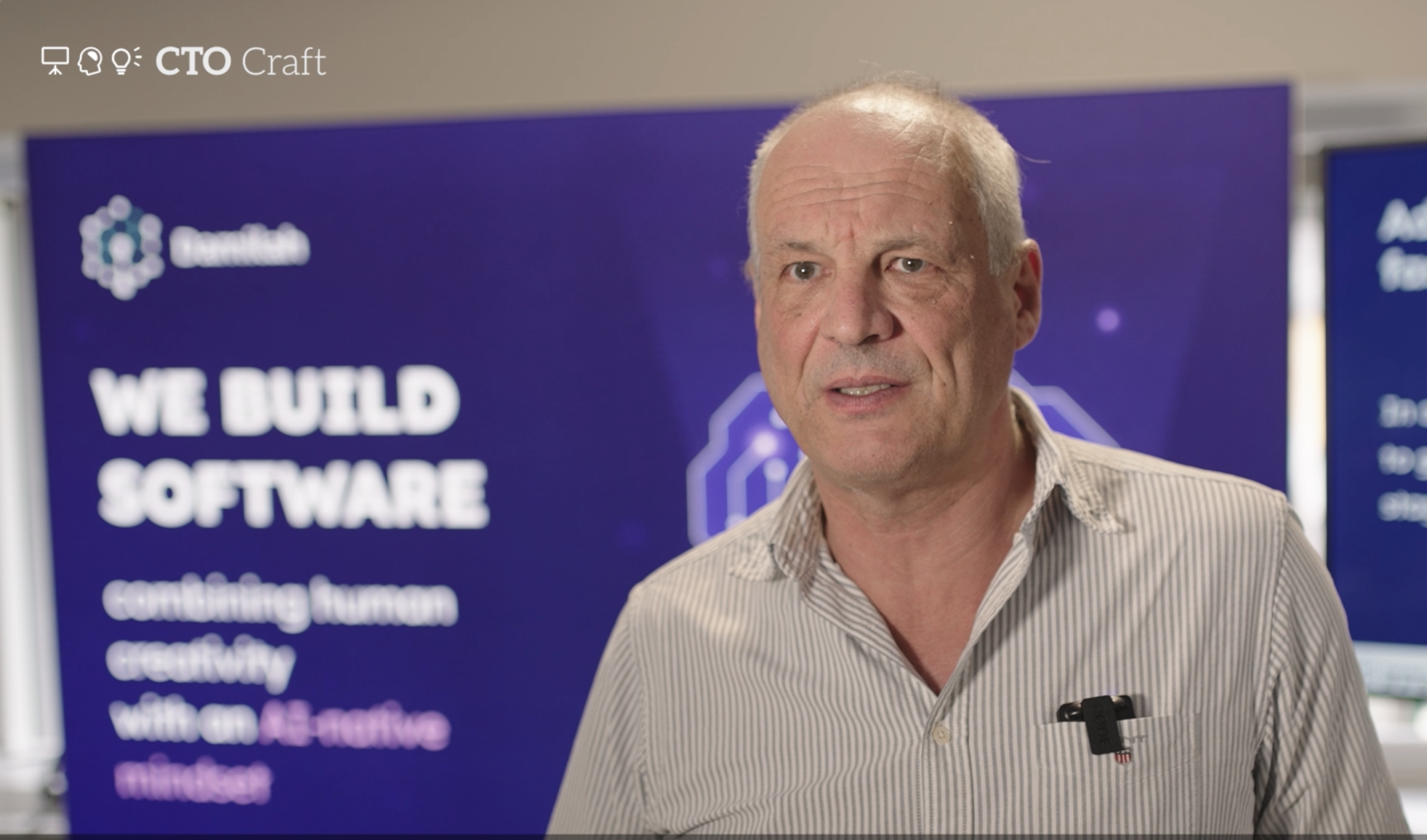
Engineering 2028: The AI maturity journey | Iain Bishop at CTO Craft Con 2026
AI maturity starts with rethinking how software is built, how teams are structured, and what the “senior” title really means in an AI era. Organisations that move beyond experimentation are willing to question their operating model, not just layer AI onto the way they’ve always worked.

Subscribe to our newsletter
Sign up for our newsletter to get regular updates and insights into our solutions and technologies
eBook
Delivering Great Software on Time
More than anything, companies should be considering how they can achieve a better balance in their workforce. UK-based businesses will always need to have employees in this country, especially those who are in customer-facing roles. However, when it comes to other positions, such as software engineers, it’s even more important to take a carefully considered view on where to base them.
Near-shoring – or, partner-shoring, where a client and near-shore partner work closely together as a single team to achieve common goals – is a solution that can not only help to keep costs down, but also reduce your risks and increase flexibility when it comes to resourcing.
It’s not just about the money…
One of the most obvious and immediate benefits of partner-shoring is financial, which can be a huge upside, especially when a lot of businesses are just beginning to emerge from some challenging years.
What’s more, partner-shoring can offer a greater degree of certainty, where your labour costs are fully known. Any company that has just hired a lot of UK-based employees will now be reeling from the shock of the Budget, as few anticipated the NI hike, or for it to be quite so extreme. And, of course, there’s no certainty that the costs to employers will stop there – there may well be further increases in taxation to come.
By partner-shoring, it’s possible to agree costs in advance and only pay for the work that is produced for you – so, for example, not having to cover people’s sick leave or parental leave which can often be an unknown quantity.
Having clarity on costs in this way makes it a lot easier for companies to plan ahead, particularly in these uncertain times when a wide range of external factors beyond mere NI rises – such as volatile market conditions – can create significant challenges for businesses.
Added to this is the enormous benefit of flexibility. The ability to scale up and down relatively painlessly is a valuable attribute for many businesses, and having a near-shore partner allows you to do this seamlessly, while the responsibility of employee protections remain the concern of the business you’re partnering with.
Acting responsibly for maximum value
That said, it’s important to emphasise that outsourcing some of your company’s labour requirements shouldn’t mean acting irresponsibly or turning to an unethical supplier that exploits its workforce.
In the outsourcing sector, there are undoubtedly bad actors in relatively deregulated markets who will underpay their employees and offer them few, if any, benefits in order to keep costs as low as possible.
In my experience, there is no value in this for anyone involved. Companies that do not invest in their workforce will earn very little loyalty from their employees. This can lead to not only lower productivity and poor outputs, but also high attrition rates that result in large amounts of key knowledge being lost on a regular basis.
On the other hand, near-shore firms that invest in their people and constantly work hard to ensure they have good employee experiences will always deliver fewer risks and greater benefits – and therefore greater value – to their clients. And that’s exactly what we believe in, here at Damilah. We invest heavily in training to ensure we enable our people to reach their full potential, as well as offering an attractive benefits package. By doing this, our employees pay us back many, many times – and our clients also reap the rewards of this.
In particular, we are proud that our annual staff turnover rate is just 2%. This saves on the expense of recruitment and onboarding (thus helping to keep costs lower for our clients), ensures that essential knowledge and experience remains within the company and is there for our clients’ benefit, and increases the quality, consistency and speed of our outputs.
Look before you leap
One final point to make is that, although the severity of the measures regarding NI may have come as a shock to many, you should avoid making a knee-jerk reaction.
It may be tempting, for example, to immediately cut your UK workforce or instantly put a freeze on recruitment, and transfer as many roles as possible overseas. While this may ultimately be the wisest course of action for certain businesses, it’s important to take a considered approach to finding the optimum balance in your workforce, rather than immediately jumping to the first solution that springs to mind. It’s also worth taking the time to find the right partner to work with.
Here, the benefit of experience and expertise can really pay dividends and help you to deliver the value for money and flexibility your company requires.
At Damilah, we have decades of experience that we are happy to share, as well as a team of highly skilled and motivated near-shore employees who partner effectively with our clients to deliver outstanding outcomes.
To find out more about how you can minimise the impacts of the Budget on your business, get in touch now to discuss our range of services.
Iain Bishop, founder and CEO, Damilah